
Tales RPG: AI Text Adventure
DWStudioAdventure
4.383.00 Reviews
- Version
- 98
- Installs
- 10.00K
- Age Rating
- Mature 17+
Screenshots
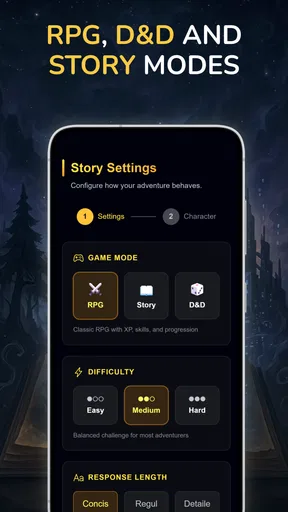
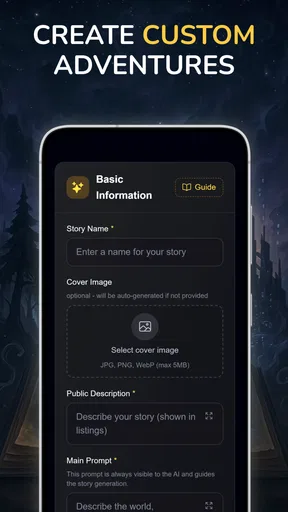
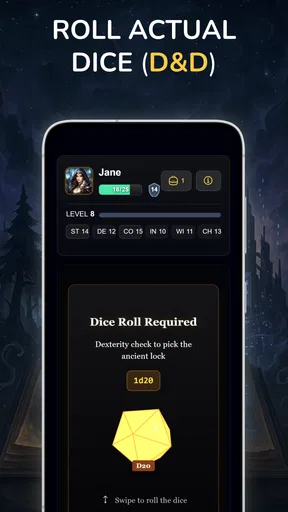
Our Review of Tales RPG: AI Text Adventure
 Analysis by Appyee
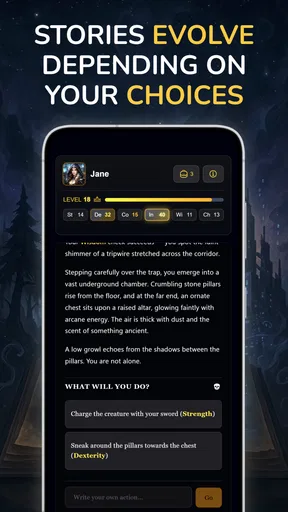
I went into Tales RPG: AI Text Adventure expecting a lightweight choose-your-own-adventure game, but its appeal is more personal than that. The central idea is to shape a hero and make decisions inside a text-driven adventure whose direction is generated with AI. Instead of watching a fixed sequence unfold, I felt as if I was negotiating with a story that could react to the kind of character I wanted to play.
That makes it an interesting fit for people who enjoy reading, improvising and testing consequences rather than chasing fast reflexes. It is a free adventure game from DWStudio, rated Mature 17+, and it runs on Android devices using version 6.0 or later. The current version is 98, which gives the game a fairly mature presentation for a small title, although the experience still depends heavily on how much imagination and patience the player brings to it.
My overall impression is positive but specific: this is best treated as a flexible storytelling playground, not as a conventional role-playing game with a clearly measured campaign. Its strongest moments come when I commit to a character and accept unexpected turns. Its weaker moments appear when I want firm rules, visible objectives or a carefully balanced difficulty curve.
Building a hero before chasing a victory
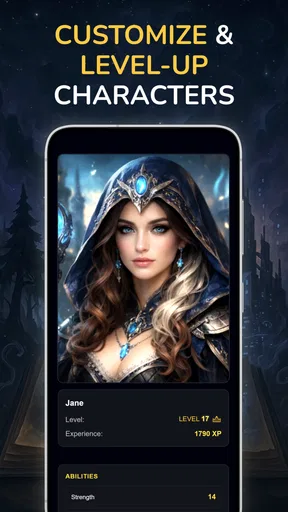
The early appeal comes from having a reason to make decisions. The game asks me to choose a path and build a hero, so the first useful goal is not simply “win.” It is deciding what kind of person I want this character to be. A cautious survivor, an ambitious explorer or a reckless troublemaker can approach the same situation with a different attitude, and that personal framing gives the text more meaning.
I recommend starting with a simple character concept rather than trying to invent a complicated biography. Give the hero one clear motivation and one obvious weakness. For example, a character who wants status but fears direct confrontation is easier to role-play consistently than a hero with ten unrelated traits. This small preparation makes the generated scenes feel more connected because my choices have a recognizable direction.
The first sessions are also where I decide whether the format suits me. If I enjoy reading a situation, imagining the surroundings and choosing an action without needing a large amount of visual feedback, the game becomes inviting very quickly. If I need animated combat, map exploration or a constant stream of rewards, the opening can feel too quiet.
One of the more useful habits is to treat each decision as a story commitment rather than a button press. I found that choosing the safest answer every time can flatten the adventure. Taking a controlled risk usually creates more interesting material, even when the result is inconvenient. That does not mean choosing randomly; it means accepting that a good story needs setbacks as well as victories.
The AI-driven format also changes what “progress” means. In a traditional adventure, I might be working toward a visible boss, a new weapon or the next map. Here, an early goal can be much smaller: earn an ally’s trust, escape a dangerous situation, uncover a secret or establish a reputation. These goals are satisfying because they belong to the character I created, even when they are not presented like a standard quest checklist.
Why the first decisions matter
I would not rush through the opening text. The initial choices establish the tone of the run, and they can influence how I interpret everything afterward. A serious character played through silly decisions may still be entertaining, but the story becomes less coherent. When I pause to ask, “What would this hero actually do?” the experience feels more deliberate and less like selecting random prompts.
There is also a practical benefit to keeping the first run focused. Since the game is built around dynamic text, I can easily create a broad, ambitious scenario in my head that the moment-to-moment play cannot fully support. A narrower premise works better: survive a journey, investigate a threat or gain influence in an unfamiliar place. Once I understand the rhythm, I can experiment with stranger ideas.
This is one of the title’s clearest differences from a conventional adventure app. The game does not need to give me a huge world before I begin; I supply part of the structure through my choices. That is liberating, but it also means I share responsibility for keeping the story engaging.
Reading progress when there is no obvious level ladder
Progress signals are less tangible than in a standard RPG. I look for changes in the situation, new complications, altered relationships and the consequences of earlier decisions. A decision feels valuable when it closes one possibility and opens another, even if I do not receive a conventional reward immediately afterward.
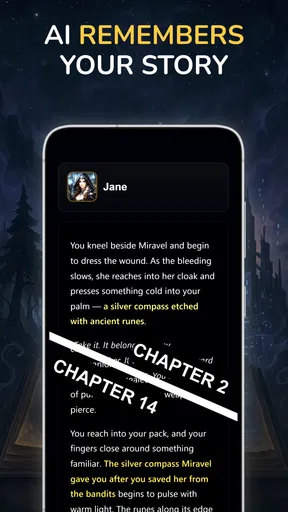
This design can be rewarding for readers who enjoy cause and effect. I might make a choice early in a session and later notice that it has shaped how another character treats the hero or how a problem develops. The satisfaction comes from recognizing the connection. It is a quieter form of progression than collecting equipment, but it can be more memorable when the chain of events feels personal.
The trade-off is that the game may not always tell me whether I am advancing efficiently. Players who want a clear experience bar, a visible rank or a reliable list of unlocks may find the feedback too soft. I can understand what happened in the story, but I may not always know whether I am moving toward a defined endpoint or simply generating another episode.
For that reason, I use a small personal record when I am playing a longer scenario. I note the hero’s main objective, important promises and unresolved threats in a few words. This is not a requirement of the game, but it gives the adventure continuity and makes later choices easier. It also prevents me from forgetting why a particular character or location matters.
That note-taking habit reveals an important strength and weakness at the same time. The game gives me room to shape the narrative, but it does not replace my own memory and judgment. Players who enjoy filling in those gaps will see freedom. Players who expect the app to organize every thread may experience the same freedom as a lack of direction.
Challenge without a conventional difficulty curve
The challenge in a text adventure is not only whether the hero succeeds. It is also whether I can make a meaningful decision when every option carries a cost. A difficult scene may involve choosing between safety and information, loyalty and self-interest, or immediate relief and a larger danger later. That kind of challenge depends on interpretation rather than reaction speed.
I found the best approach was to judge risk according to the character’s situation, not according to my desire to force progress. If the hero is tired, isolated or poorly prepared, a bold move should feel genuinely dangerous. If I always choose the most dramatic action, setbacks can become predictable. Alternating between careful planning and deliberate risk creates a better rhythm.
Still, this is not the same as a tightly tuned combat system. The game’s dynamic text can make difficulty feel uneven because the pressure comes from the evolving narrative rather than from a fixed set of encounters. Some moments may feel tense because the circumstances are clear and the consequences matter. Other moments may feel less demanding if the available choices do not create enough contrast.
That unevenness is an important expectation to set. I would not recommend this game to someone searching for a precise challenge curve, competitive balance or a puzzle adventure where every obstacle has one carefully tested solution. A traditional RPG or strategy game is likely to be more satisfying for that player.
For readers who enjoy uncertainty, however, the absence of a rigid curve can be part of the attraction. I am not merely solving the developer’s intended route. I am helping define what counts as success. Escaping with a damaged reputation may be a victory for one hero and a failure for another. That personal standard gives the game room to support different play styles.
Keeping momentum between major moments
Pacing is where my experience depended most on how I played. A short session works well when I want a quick imaginative break: I can make a few decisions, see a situation change and stop before the story becomes demanding. Longer sessions require more commitment because text adventures do not provide the same visual stimulation as an action game.
I found it helpful to divide a run into small chapters. Instead of expecting one continuous epic, I treated each session as a goal with a beginning, a complication and a temporary outcome. This approach creates momentum even when the larger story remains open. It also makes it easier to return later without feeling that I have forgotten the entire adventure.
The game’s pacing is strongest when my choices create pressure. A deadline, a fragile alliance or a dangerous unknown gives each paragraph a reason to matter. When I play without a concrete objective, the experience can become more passive. That is not necessarily a flaw in the app; it is a sign that its open-ended structure benefits from a player who actively supplies direction.
Another useful technique is to avoid making every decision maximally dramatic. If every scene is treated as a crisis, the story has nowhere to rise. Quiet choices, investigation and preparation make later danger feel more significant. This is a subtle but important way to improve the pacing myself, because the game gives me control over the tone of the journey.
Where retention helps and where it can feel like pressure
The main reason I would return is unfinished narrative business. A character may still have a promise to keep, a threat to understand or a consequence to face. That kind of retention feels natural because it comes from curiosity. I want to know what happens next, not because a timer is pushing me, but because my previous decisions created a question.
There is also replay value in changing the hero’s priorities. A second run can feel different when I play someone less cautious, more loyal or more self-serving. The appeal is not necessarily discovering a fixed alternate ending; it is seeing how a different attitude changes the path. This makes the game particularly suitable for people who enjoy comparing “what I did” with “what I could have done.”
However, open-ended replay value is not the same as guaranteed long-term progression. If I am looking for a deep unlock structure, a large collection system or a clearly expanding character build, I should approach this title carefully. Its retention comes primarily from narrative possibility and personal experimentation, not from a promise that every session will add a new mechanical layer.
The free entry point makes it easy to test that relationship with the game. In-app purchases range from $1.49 to $34.99 per item, so I would take a moment to understand what any purchase offers before spending money. The important question for me is whether I am paying to support a story experience I already enjoy, rather than buying something simply because I feel pressured to keep up.
That distinction matters because the game’s most valuable resource is attention. If I am already invested in the hero and the unfolding situation, continued play feels voluntary. If I am not connecting with the writing or the decision-making, additional spending will not solve that basic mismatch. I would use the free version as the real test of fit.
How it compares with familiar adventure alternatives
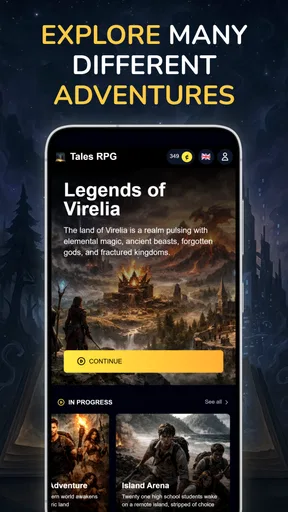
Compared with a traditional choice-based adventure, this game feels less like following a prepared branching script and more like collaborating with a storyteller. That can produce surprising directions and gives me more ownership over the hero. The downside is that the experience may feel less polished or tightly authored than a carefully scripted narrative with a fixed cast and predetermined branches.
Compared with a conventional mobile RPG, it places much less emphasis on visual spectacle and mechanical optimization. I am not opening it for fast battles or detailed equipment management. I am opening it to read, decide and imagine consequences. Someone who enjoys character builds but dislikes long passages of text may prefer a more system-heavy role-playing game.
It also differs from a standard chatbot because the adventure framing gives my interaction a purpose. I am not merely asking for isolated stories; I am trying to guide a hero through trouble. That structure makes the text easier to engage with, though it still requires me to contribute ideas and maintain a sense of direction.
In everyday use, I can imagine playing it during a quiet commute, before bed or during a short break when I want something more involving than scrolling. I would avoid starting a serious run when I have only a few seconds, because the best decisions need a little attention. The game is portable and accessible, but its ideal setting is one where I can read without rushing.
Who should try it, and who should skip it
I would recommend this adventure to readers who like interactive fiction, improvised role-playing and stories that respond to personal choices. It is especially appealing if I enjoy making my own objectives and do not need every achievement to appear as a badge or number. The Mature 17+ rating also makes it a poor choice for younger players and a reminder that its themes are intended for an adult audience.
I would skip it if I want a fully visual fantasy world, a competitive challenge, a predictable campaign or a strong equipment-and-leveling loop. I would also be cautious if I dislike AI-influenced storytelling in principle, because the dynamic nature of the text is not a minor side feature; it is the reason the game exists.
Device compatibility is reasonably broad for Android users, since the game supports Android 6.0 and later. That makes it accessible on older compatible phones, although the quality of the experience will still depend on how comfortable I am reading and entering choices on the particular screen. The title is free to start, which lowers the risk of discovering that its text-first format is not for me.
DWStudio has positioned the game as an adventure rather than a conventional action title, and that description fits my experience. The store shows a 4.3 average from over 800 ratings, with more than 80 written reviews and over 10 thousand installs. Those figures suggest a real audience, but they do not replace personal expectations: this is a niche style of game, and enjoyment depends strongly on whether I like participating in the storytelling.
My verdict on goals, unlocks and staying power
The game succeeds when I give it a clear hero, a manageable objective and permission to surprise me. Its early goals are self-directed, its progress signals are mostly narrative, and its challenge comes from weighing consequences rather than mastering a fixed mechanical system. That combination can be absorbing, but it asks me to do more interpretive work than a typical mobile adventure.
Its pacing is best when I play in focused chapters and allow quieter scenes to support the dramatic ones. Its retention is strongest when unresolved choices make me curious, not when I feel pushed to return. The lack of a clearly visible progression ladder may frustrate players who need constant unlocks, but it also prevents the story from being reduced to a checklist.
My final recommendation is therefore straightforward: try it if the idea of guiding a hero through evolving text sounds more exciting than collecting gear or watching combat animations. Start free, keep your first character simple, record the important threads and judge the experience by the quality of decisions it creates for you. Tales RPG: AI Text Adventure is most rewarding when you treat it as a shared storytelling experiment, not as a conventional RPG with a hidden scoreboard.
After spending time with it, I see a game with a clear identity and a deliberately unusual kind of progression. It will not satisfy every adventure fan, but for the right reader it offers something many fixed alternatives cannot: the feeling that the story is being shaped around the hero I chose to become.
Verdict
Strengths of Tales RPG: AI Text Adventure
- AI-generated stories adapt to your choices in real time.
- Simple text-based gameplay works smoothly on most devices.
- Many genres and settings offer varied adventure experiences.
- No complex controls, making it easy to start playing quickly.
- Creative prompts can produce unexpected and memorable story moments.
Limitations of Tales RPG: AI Text Adventure
- Story quality can vary noticeably between different adventures.
- Some responses may feel repetitive during longer play sessions.
- The AI may occasionally misunderstand commands or character actions.
- Progress and enjoyment depend heavily on writing detailed choices.
- Frequent play may require in-app purchases or subscription access.
Similar Picks in This Category
View All
Roblox
Roblox Corporation4.2

Pokémon GO
Niantic, Inc.3.5

Ninja warrior: legend of adven
TOH Games4.6

Ninja Arashi
Black Panther4.6

Eyes - The Horror Game
Fearless Games sp. j.4.5

Critical Action:Gun Strike Ops
FPS Shooter & Action Game4.3
Frequently Asked Questions
What is Tales RPG: AI Text Adventure?
Tales RPG: AI Text Adventure is an interactive role-playing game built around written storytelling rather than traditional graphics. You create or guide a character through an evolving adventure, make decisions, and describe actions while an AI-driven narrator responds to your input. The story can change according to your choices, making each session feel more personal and unpredictable.
How does the gameplay work in Tales RPG: AI Text Adventure?
Gameplay is based mainly on reading narrative passages and entering decisions or actions in response. The AI acts as a game master, describing locations, characters, challenges, and consequences as the adventure develops. You are not limited to a small list of preset commands, so creative responses may lead to unexpected solutions, although the quality and consistency of the story can depend on how clearly you write your instructions.
Does Tales RPG: AI Text Adventure require an internet connection?
An internet connection is generally important because the game relies on AI-generated storytelling and remote processing to create responses. You may be able to open parts of the application offline, but starting new scenes or continuing an active adventure can require access to the service. If you plan to play while traveling, check the current app requirements and expect limited functionality without a stable connection.
Is Tales RPG: AI Text Adventure suitable for children?
Suitability depends on the age rating, available content controls, and the type of stories created by the player. Since AI-generated adventures can include mature themes, violence, frightening situations, or unexpected language, parents should review the app’s settings and privacy information before allowing younger users to play. It is best treated as a customizable storytelling experience for teens or adults unless parental supervision is available.
Is Tales RPG: AI Text Adventure free to download and play?
The application may be available to download without an upfront charge, but access to certain features can depend on advertisements, in-app purchases, subscriptions, usage limits, or an AI message allowance. Before beginning a long campaign, review the store listing and purchase screen carefully so you understand what is included in the free version. Pricing and available plans may also vary between Android and iOS.
Play our best games!


